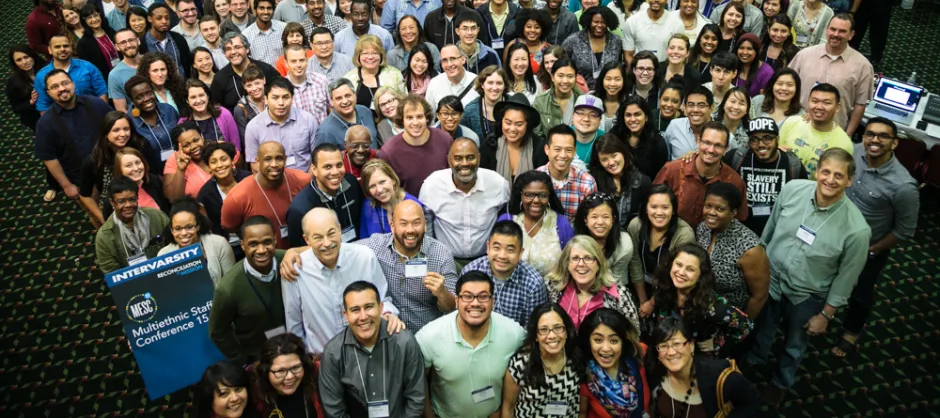
InterVarsity's Commitment to Ethnic Reconciliation & Justice
In the early 1990s, Steve Hayner (then InterVarsity/USA president) and Samuel Escobar (former IVCF/Canada president) convened a task force of 30 people, both within and outside of InterVarsity, to articulate a theological foundation for multiethnicity in InterVarsity as a movement. InterVarsity/USA revised and updated the paper in 2024 to reflect 30 years of additional theological reflection.
For a PDF version of the paper, click here.
Our Commitment to Ethnic Reconciliation & Justice
InterVarsity Christian Fellowship/USA embraces a core value of Ethnic Reconciliation and Justice, which we describe this way: “We pursue ethnic reconciliation by practicing mutual empowerment, grace and truth, and by promoting personal & systemic justice.”
This paper expresses our commitment, confession, and convictions as a staff community.
Prologue: United Diversity and the Mission of God
InterVarsity’s commitment to ethnic reconciliation and justice grows from our desire that the gospel of Jesus Christ governs the ways we relate to one another and the ways we carry out our ministry. It flows from our study of the Scriptures, our faithful engagement with relevant academic disciplines, and our understanding of the person and work of Jesus Christ.
From the beginning, God intended to reconcile people of every nation, tribe, and language as members of a united family through Jesus Christ’s death and resurrection – in spite of pre-existing hostility, both personal and systemic. God called Abram and said, “I will make you into a great nation, and I will bless you.” (Genesis 12:2) God turned this barren older couple into a large family and established a covenant with them. Yahweh would be their God, and they will be Yahweh’s people. God also promised that all the nations would be blessed through them. (Genesis 12:3b) Building on that promise, the Old Testament psalmists and prophets pointed to a time when those who were not Abraham’s descendants also would be known as God’s people. (Psalm 72:11; 117:1; Isaiah 19:25; Jeremiah 3:17; Zephaniah 2:11; Zechariah 9:10)
What the Old Testament prophets foretold becomes reality in the New Testament. Paul repeatedly announces that through Christ, Christians who are not Jewish have been grafted into this people without first needing to become Jewish. (Romans 11:17; Ephesians 2:11-22; 3:3-10; Galatians 2:11-3:9; Colossians 1:24-27). The challenge of how this diverse community will become one catalyzes many of Paul’s pastoral challenges and resulting letters.
Even as Scriptures emphasize the unity of the body of Christ, the ongoing diversity within Christ’s body never recedes from view. Paul uses the persistence of ethnic and social differences in Christ’s body as an analogy to explain the diversity of spiritual gifts in Christ’s body. (1 Corinthians 12:4-14) He condemns Peter’s attempt to require Gentile believers to become Jews. (Gal 2:11-16) John continues to see human diversity (“every tribe and language and people and nation”) persisting before the heavenly throne. (Revelation 7:9) Unity is not reduced to assimilation. Diversity does not lead to disunity. United diversity is a defining aspect of the reconciled body of Christ. Paul and other New Testament writers constantly reference this reconciled new family and its shared history, expecting it to shape our understanding and life together.
Reconciliation is shorthand for the whole plot of the biblical story and is the goal of the gospel. It focuses on the reconciliation of a divided humanity into a new community and the reconciliation of that new community to God. (Ephesians 2:14-16) It points beyond that to the reconciliation of all things in Christ (Colossians 1:19, 20). Its source, power, hope, and epitome are the cross and resurrection of Jesus Christ. The ministry of reconciliation calls the Church to a cruciform mission which fully reflects God’s justice and righteousness, as well as God’s mercy and love.
In Scripture, God’s justice is a sign of God’s reign and rule being experienced on earth as it is in heaven. It overcomes evil, eliminates injustice, restores right relationships, and addresses the harms caused by injustice and sin. (Isaiah 1:17; Jeremiah 22:3; Micah 6:8) Justice advances and reflects God’s ultimate purpose – to restore a sin-wracked creation by bringing shalom, a word whose semantic field includes the ideas of peace, wholeness, health, security, well-being, and holistic salvation. This is the trajectory of the new creation. (Isaiah 60-61; 65:17-25; Ezekiel 47:1-12; Revelation 21-22:5) Human justice, as defined by Scripture, is shaped by the contours of God’s justice. It requires that that our ministry honestly engage present and past alienation and pain, both collective and individual, with lament, repentance, forgiveness, and repair.
Our Witness & Confession
Since our founding, we have attempted to live out our commitment to ethnic reconciliation and justice, at times strongly and at times haltingly. At our best, we have recognized and advocated for the dignity and value of people of every ethnicity and culture. This has required us to challenge systems and individuals. For example, in the early 1940s, our first president, C. Stacey Woods, allowed no distinction in staff assignments based on race. He rebuked and refused to use camps and conference centers which prohibited InterVarsity from bringing both Black and White students to the venue. In the decades that followed, we have continued to express this commitment. We have consistently published on the topic through multiple articles in His magazine and books from IVP. In the 1960s, we sponsored raciallyintegrated conferences in the South in the early 1960s, and we spotlighted prophetic speakers and diverse worship teams at Urbana beginning in the 1970s. We made on-going enhancements to our funding systems to better support staff of color (e.g., the multiethnic 1% (1980s), the Multiethnic Staff Growth and Retention Fund (1990s), contextualized Ministry Partnership Development tools (2000s), and a commitment to use a significant percentage of all undesigned estate gifts to support staff of color and women (2020s).) These were matched with targeted programs in leadership development beginning in the 1990s.
We also have frequently failed to live out our commitments fully. We have not become a ministry where staff of color consistently thrive or where students and faculty of color consistently experience wellcontextualized ministry. To this day, staff of color experience the pain and inequity of funding systems that still rely significantly on individual funding networks; the disproportionate burden of representing their entire community on task forces and committees; the need to code switch in order to be heard and understood by supervisors who may be insufficiently skilled as cross-cultural managers; and a ministry context which all too often assumes White cultural norms. We long to do better in having our organization match our convictions.
Our Convictions
1. The God-Given Value and Dignity of All Humanity
Because humanity bears God’s image, we affirm that all people and all ethnic groups deserve respect and honor. The existence of linguistic and cultural diversity reflects the God-designed diversity found in creation, and every ethnic group expresses something of God’s character and truth. The peoples of the world are envisioned by the writers of scripture as possessing gifts. Their cultures, languages, customs, stories, and artifacts are pictured converging at the point of their origin to honor the God from whom they came in the first place. These gifts of God’s grace, common to all, realize their special purpose before God’s throne, bringing their diverse gifts to worship God and bear witness as the church. So, we identify (where undiscovered), highlight (when ignored), and lift up (when oppressed) those elements of God’s truth which exist in every ethnic culture. God created people for a life of harmonious relationships with God, with other human beings, and with creation. We reflect the Creator’s love for all people when we advocate for and create contexts in which all flourish free from injustice.
(Genesis 1:26-31; 2:19-23; 9:1-3, 18-19; 10:4, 20, 31-32; 11:4-9; Isaiah 40:25-31; 60; John 1:1-3; Acts 14:16-17; 17:26-27; Colossians 1:15-17; Revelation 21) *
We affirm this because:
- As God’s image bearers, Adam and Eve extended God’s creative work by making something of their world—material goods, ideas, art, and patterns of relating and social processes. There is so much to celebrate, to mourn, and to redeem in our cultures.
- The Bible emphasizes God’s love and care for all peoples, often disrupting the exclusiveness of xenophobic groups in order to reveal himself to peoples of all ethnic groups.
- We honor God and God’s people everywhere in the world by becoming more open to ethnically diverse forms of worship and methods of evangelism and training.
It is appropriate and timely for InterVarsity to affirm our commitment to ethnic diversity because:
- We rejoice in the ethnic diversity exhibited in the university and our campus groups and in the cultural gifts which staff, students, faculty and partners bring to InterVarsity, while desiring to submit all our conclusions to a holistic understanding of Scriptural norms.
- Christian community is most fully expressed only when ethnic heritage and individual giftedness are valued.
(Acts 10-11; Jonah 1-4; Daniel 1-7, 9; Acts 15:1-21; Acts 15:22-35; Colossians 3:10-11; Revelation 5:6-10; 7:9-11; Acts 6:5-7; 10:34-38, 44-48; 11:18;15:7-11, 22-35; Revelation 7:9-11)*
2. The Power of Christ's Atoning Sacrifice for Reconciliation
We embrace Christ’s call to pursue both divine and human reconciliation. Christ’s atoning death is the basis for restored human community as well as restored fellowship with God. Through the cross, God has defeated the powers of sin and death, including those powers that breed and maintain hostility toward others. Further, in the cross, the God calls human beings to be reconciled with the Triune God and with one another and to belong to the united and diverse people of God. All the walls of division that separate people and suppress their flourishing are torn down.
(Ephesians 2; 2 Corinthians 5:11-21; Galatians 3:22-29)*
We affirm this because:
- Christ has called his disciples to be his ambassadors and ministers of reconciliation.
- In Christ, peoples of all cultural and ethnic heritages can freely confess sin and forgive one another, creating a visible community united by mutual love and working together in service and mission.
It is appropriate and timely for InterVarsity to affirm our commitment to reconciliation because:
- The cultural perspectives and Spirit-filled experience of Christians outside of our own limited – and sometimes nondiverse – social networks are valuable for discerning God’s voice in the world. Even sincere believers have maintained a vested interest in neither hearing nor seeing what God is communicating through diverse others.
Humility and partnership will cause us to continually reassess our ministry goals, staffing strategies and funding priorities in light of our gospel commitments and mission. - We honor the legacy and example of those who, even at great cost to themselves, have followed Christ by humbly pursuing reconciliation.
(2 Corinthians 5:11-2 1; Colossians 3:8-17; Acts 1:8; 26:12-23; Matthew 28:16-20; Mark 7-8; John 4:4-42)*
3. Humanity's Need for God's Justice and Redemption
We acknowledge human failure to achieve reconciliation and the need for every culture to be transformed. Everyone, everywhere, has rebelled against God. The sin of pride which separates people from God and from one another also manifests in the way that ethnocentricity and partiality of both individuals and groups have led to prejudice and injustice. Human groups exclude, rather than include, others who are different. Dominant groups oppress and exploit. These prejudicial, oppressive, and exploitative tendencies often have found expression in the ways that humans have assigned value to each other based on the perception of shared physical traits – thus creating the category of “race” and the evils of “racism.” In addition to the sense of people that ethnicity creates, racial identity also exists and matters. The fabric of our society – including its systems, structures, and institutions – and the patterns of our behaviors reflect, permit, and perpetuate prejudice and racism. This affects all cultures, reflects our common fallenness, and prevents people from flourishing according to God’s intention. We all need to repent of such unrighteous attitudes and actions. We all need to embrace the call to embody God’s justice and redemption in all that we do.
(Genesis 3; Isaiah 10:1-2; Habakkuk 1-2; Romans 1-3; Galatians 2)*
We affirm this because:
- The tendency to demean the identity and diminish the worth of those who are different by establishing unbiblical, prejudicial, or racist categories has robbed individuals, communities, and churches of a sense of their true dignity before God, of the honor and affirmation they rightfully deserve, and of the opportunity and resources to serve God and others.
- Ideologies which promote the superiority of one people over another, including racism and white supremacy, are sinful — abhorred by God and condemned by Scripture because they deny Scripture’s affirmation of the equal value and dignity of all people.
- Believers need each other to resist fallen humanity’s natural tendencies to consider ethnocentric viewpoints as the presuppositions for determining truth or establishing privilege.
- Christians, including the students, and faculty that we are forming, are called to be a prophetic people who work at righting injustices and healing the wounds of oppression.
It is appropriate and timely for InterVarsity to affirm our commitment to justice and redemption because:
- The challenge to overcome prejudice and racism begins with us and in the communities in which we worship and serve. We have too often failed God and our siblings in Christ by ignoring the reality and real harm of prejudice and racism.
- A society in which racial injustice thrives is one in which all people are malformed, falling short of the united diversity that should characterize the body of Christ.
- The campus environment offers competing interpretations of and solutions for injustice, diversity, equity, and inclusion. However, we believe the gospel provides a unique vision and unique resources that makes a valuable contribution to those goals and that can find common cause with non-Christians who shares these goals.
(Galatians 2:1-21; Jonah 1-4; John 4:4-42; 1 Corinthians 1:10-31; Acts 10:23-28; 11:1-2; 15:1-5; 26:1-11; Galatians 2:11-14)*
4. God's Intention for Multiethnic Witnessing Communities
We commit ourselves to the body of Christ as the living sign of God’s Kingdom. God’s intention is to create a new humanity from every people and nation. In the power of God’s Spirit, followers of Jesus are to become a multiethnic and diverse community that expresses the unity of the body of Christ as it lives out the values of the Kingdom. We yearn for all peoples to flourish in the context of renewed relationships with their Creator and with each other. Although our efforts will always be imperfect, we seek to embody the qualities of the new community which God one day will bring in its fullness.
(Genesis 12:1-3; Daniel 1-6; Galatians 3:26-29; Colossians 1; 1 Thessalonians 1; Ephesians 2; Acts 8-15)*
We affirm this because:
- Believers of all ethnic backgrounds are called to follow Christ in ministering together to the full range of human needs which demand compassionate response and gospel witness.
- Our understanding of Scripture, community, and of God is enriched by insights originating in diverse ethnic heritages.
It is appropriate and timely for InterVarsity to affirm our commitment to multiethnic witness because:
- In times of polarization, the reconciling power of the Gospel is best demonstrated by authentic Christian community which unites people across social barriers. We are convinced that a wide variety of multiethnic expressions in worship and witness offers inviting, visible evidence of the reality of God’s kingdom.
- We endeavor to be peacemakers, serving as bridges toward the reconciliation of people separated by suspicion, hatred, abuse of power, and unjust systems – demonstrating patterns for mutual empowerment, and service.
- We affirm InterVarsity’s commitment to “love people of every ethnicity and culture” as essential to the Church's mission of proclaiming Christ to the whole world.
- We affirm InterVarsity’s commitment to train students and staff to faithfully navigate the multiethnic realities they encounter.
(Acts 6; 8; 10-11: 15; Acts 2:42-47; 4:25-37; Romans 12; Isaiah 61:1-11; Luke 4:14-30; 6:17-36; Matthew 25:31-46; James 5:1-6; Revelation 21:1-8; Genesis 20; 41:50-52; 50:15-5 1; Joshua 2:8-14; Ruth 1-4; Job 1-42; Matthew 4:23-5:16; Matthew 8-9; Mark 7-8; Luke 10:25-37; John 4:4-42; Acts 2; Romans 11:11-36; 2 Corinthians 5:11-21; John 3:16-17; Acts 2; Revelation 7:9-11; Acts 1:8; Matthew 28:16-20; Mark 7-8; John 4:4-42; Acts 6:1-7; 11:19-26; 13.1-3; 14:26-28; 15; Galatians 2: 1-10)*
Conclusion
As followers of Christ called to reach an unbelieving yet searching segment of society, InterVarsity is convinced that the manifold grace of God expressed in multiethnic worshipping communities offers inviting, visible evidence that God is bringing all things together under Christ who enacts justice, righteousness, reconciliation and unity amongst all people. We look forward together to being counted among that “great multitude that no one could count, from every nation, tribe, people and language, standing before the throne and in front of the Lamb” (Revelation 7:9).
May 2024